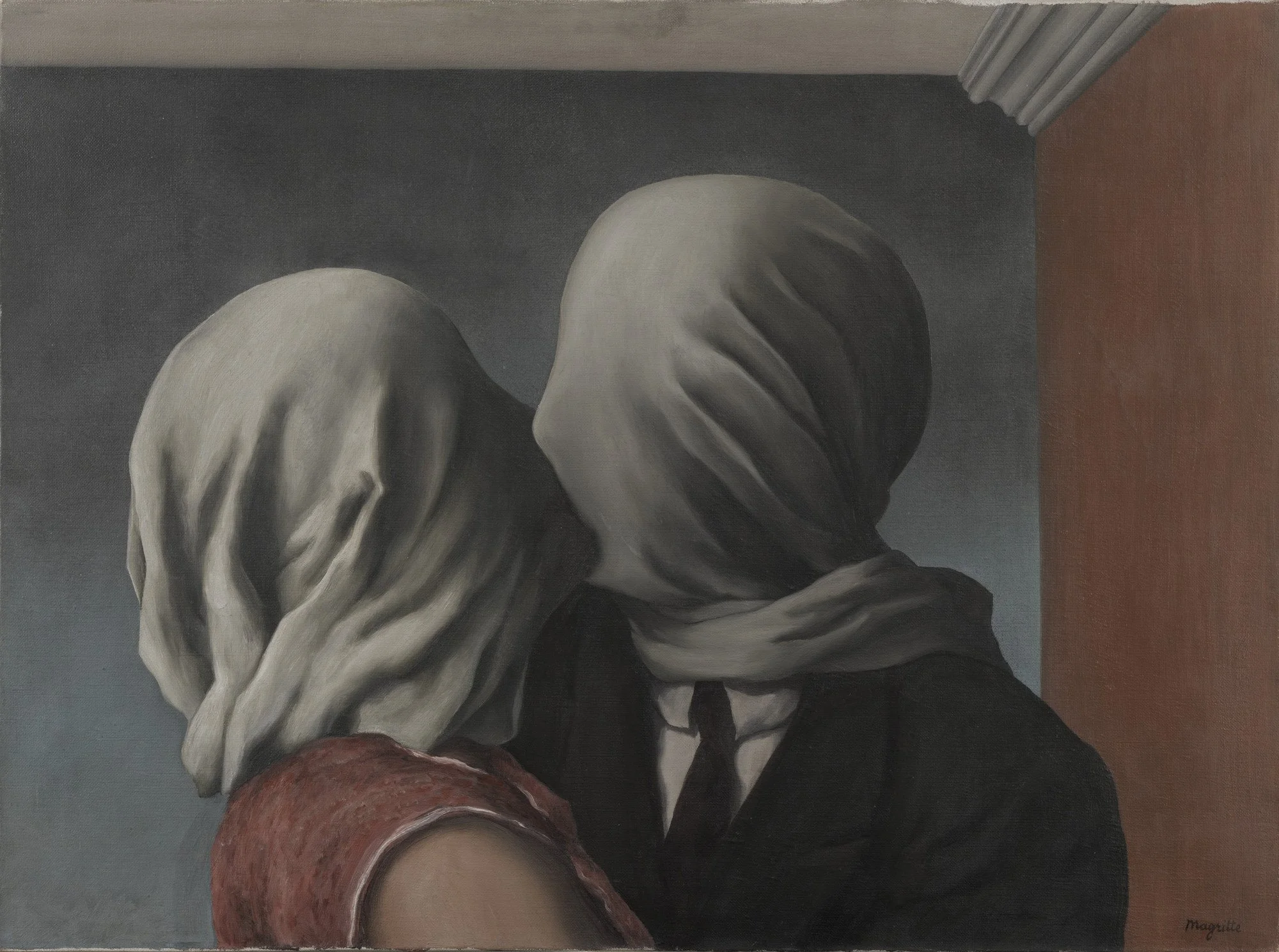
Every century invents its own myths of love.
Camus never believed in perfect love; he believed in imperfect people—ordinary, breakable—who go on loving one another without illusion. For him, love begins where fantasy ends.
In The Myth of Sisyphus (1942), he called life absurd: a hunger for order in a world that will not explain itself. Is it possible that asking another person to make the world make sense only adds to the absurdity?
Romanticism, born in the late eighteenth century, promised that love could redeem the self. Its poets and painters made passion divine, the beloved a mirror of the soul. Centuries later, that story still governs us. Society teaches that a partner should complete what feels unfinished.
Camus would have called that worship—or obsession—the attempt to make a human being bear the weight of meaning itself. Worship can blithely exist, but it will always fail true partnership. A great beauty of love may be found precisely in its limits. What gives it power is that it cannot save us. To accept that boundary is to love as Camus lived—lucidly, without demand for forever.
Camus’s alternative to illusion is lucidity: the courage to see clearly and love anyway. To love someone, for him, was to see them as they are—flawed, free, separate—and to remain by their side, still curious, still awake to who they are.
People tend to chase the one because it is easier than facing that life itself is incomplete. Yet incompleteness makes tenderness possible. What cannot be perfected can still be held with care. As Camus wrote, “There is no love of life without despair of life.” The ache, the limit—these are not failings but the terms of our humanity. They mistake nearness for meaning, the heat of touch for the light of understanding.
Love, at its most human, respects distance. It doesn’t seek to merge but to meet—again and again—across the small, necessary space between two lives. To demand perfection of love is to deny the condition of being human.
Was Camus’s clarity too harsh? Or was it, in its way, a form of mercy—a call to stop asking love to make us whole, and to let it make us real instead?
Two people, lucid, choosing presence over promise—sharing the weight, and the wonder, of being alive.
Camus called that the beginning of love:
to see another without looking.
Further Reading on Camus
The Myth of Sisyphus (1942) – Camus’s defining essay on the absurd: the human hunger for meaning in a silent world.
The Stranger (L’Étranger) (1942) – A minimalist novel of detachment and honesty; Meursault’s refusal to pretend remains timeless.
The Plague (La Peste) (1947) – A parable of compassion and endurance in crisis; love and solidarity in an absurd world.
The Rebel (L’Homme révolté) (1951) – Camus’s mature philosophy: measured revolt, human dignity, and the ethics of limits.
Lyrical and Critical Essays – Early essays filled with Mediterranean light and sensual clarity; includes “Love of Life” and “Nuptials at Tipasa.”
Notebooks 1935–1942 – Private reflections on lucidity, desire, and writing; an intimate companion to The Myth of Sisyphus.
The Fall (La Chute) (1956) – A haunting confession exploring guilt, love, and moral self-awareness.
Great Essays and Books About Camus
Susan Sontag — “The Mind as Passion” (in Against Interpretation, 1966) A lyrical and penetrating reading of Camus as a sensual moralist who turned clarity into an ethic.
James Wood — “The Seriousness of Albert Camus” (The New Yorker, 2013) A contemporary reconsideration that situates Camus between moral rigor and the impossibility of faith.
Pankaj Mishra — “The Return of the Prophet: Camus in Our Time” (The Guardian, 2012) A brilliant essay on why Camus’s ethics of limits and revolt remain urgent in modern politics and culture.
Art on Exhibition
If you’re in New York and wish to see The Lovers (1928) by René Magritte in person, it’s currently on display in the Surrealist section (Floor 5) at MoMA.